
A Wake-Up Call for Remote Workers
Not so long ago, working from home felt like winning the career lottery. No commute. No office small talk. No one stealing your coffee cup. Just you, your laptop, and your favourite brew from the local café.
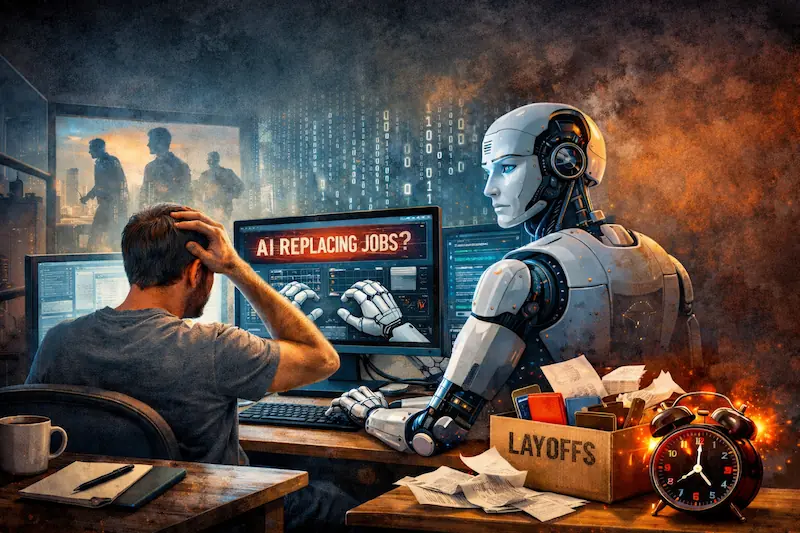
But here’s the uncomfortable question many remote workers haven’t asked yet: if your job can be done entirely on a keyboard and mouse… what’s stopping a machine from doing it instead?
Artificial Intelligence doesn’t need coffee breaks, doesn’t care about time zones, and is getting very good at the kind of work many of us do every day.
The problem is, most of us aren’t prepared for what this means. Worse, many of us are unknowingly setting ourselves up for failure.
Let me explain…
Australia, We Have a Productivity Problem
Australia has a serious productivity issue. In simple terms, we’re producing less output for the same effort. Productivity growth has been sliding for decades and is now close to zero.
For a long time, governments have effectively borrowed from the future to fund the wages, services, and lifestyles we expect today. But that model only works for so long. If we want to maintain our standard of living, we need to produce more value with the same—or fewer—resources.
That means productivity has to increase. There’s no political spin that changes this reality.
And this is where Artificial Intelligence, or ‘AI’, enters the picture.
“But I Want to Work Less… and From Home”
On the other side of the productivity debate are workers, many of whom now treat working from home as a right rather than a perk.
During COVID, remote work was a necessity. It allowed people to stay employed while keeping the country functioning. But now, with no public health reason keeping people out of offices, working from home has become a political and cultural battleground.
Here’s the issue most people miss: any job that can be done entirely from home connects to the business only through a keyboard and mouse.
And that matters.
Because if your job exists only in software, systems, email, chat, and dashboards, then it is already half-way to being automated.
AI: The Productivity Accelerator
At its core, Artificial Intelligence is simply another tool to increase productivity—especially in business. And right now, Australia’s desperate need for productivity growth and rapid advances in AI are intersecting.
People are expensive. In business terms, they’re especially expensive when doing work that is repeatable, predictable, and process-driven. Historically, automation replaced manual labour—machines on factory floors, robots on production lines.
AI changes the game. It moves automation up the value chain into desk-based, white-collar work.
Emails. Reports. Customer service. Data analysis. Content. Scheduling. Coordination. Documentation. Large parts of many office jobs are now squarely in AI’s sights.
People don’t lose jobs to AI because they’re bad at their work. They lose them because their work becomes too easy to replicate.
When Job Security Gets Uncomfortable
Here’s the brutal test: How much of your job relies on specialist judgment, and how much is simply executing known steps?
Many businesses have entire workforces whose jobs are computer-bound. Their interactions with colleagues and customers happen almost entirely via email, chat, and internal systems.
The irony? This is the exact argument often used to justify working from home – “I can do my job anywhere.”
True—but that also means it can be done by anyone… or anything!
AI systems that can interact via email and chat, sound human, follow processes, and learn from feedback are already here. Over the next two to three years, they will become frighteningly good.
Why Working From Home Increases Risk
This is why I believe working from home is dangerous for many roles.
If your entire value is delivered remotely through a screen, you become easier to replace—not because you’re bad at your job, but because you’re invisible and measurable.
From a business perspective, if productivity must increase, why wouldn’t they adopt AI that works 24/7, never complains, and costs a fraction of a salary?
When work becomes abstracted away from humans and reduced to inputs and outputs, replacing the human becomes a logical next step.
Put it all together:
- Governments demanding productivity gains
- Businesses under cost pressure
- Workers increasingly disconnected from offices
- AI rapidly improving at digital work
That’s not a future risk. That’s a perfect storm.
How to Make Yourself Harder to Replace
People don’t lose jobs to AI because they’re bad at their work. They lose them because their work becomes too easy to replicate.
The solution isn’t panic. It’s awareness, visibility, and moving up the value chain.
Here’s how.
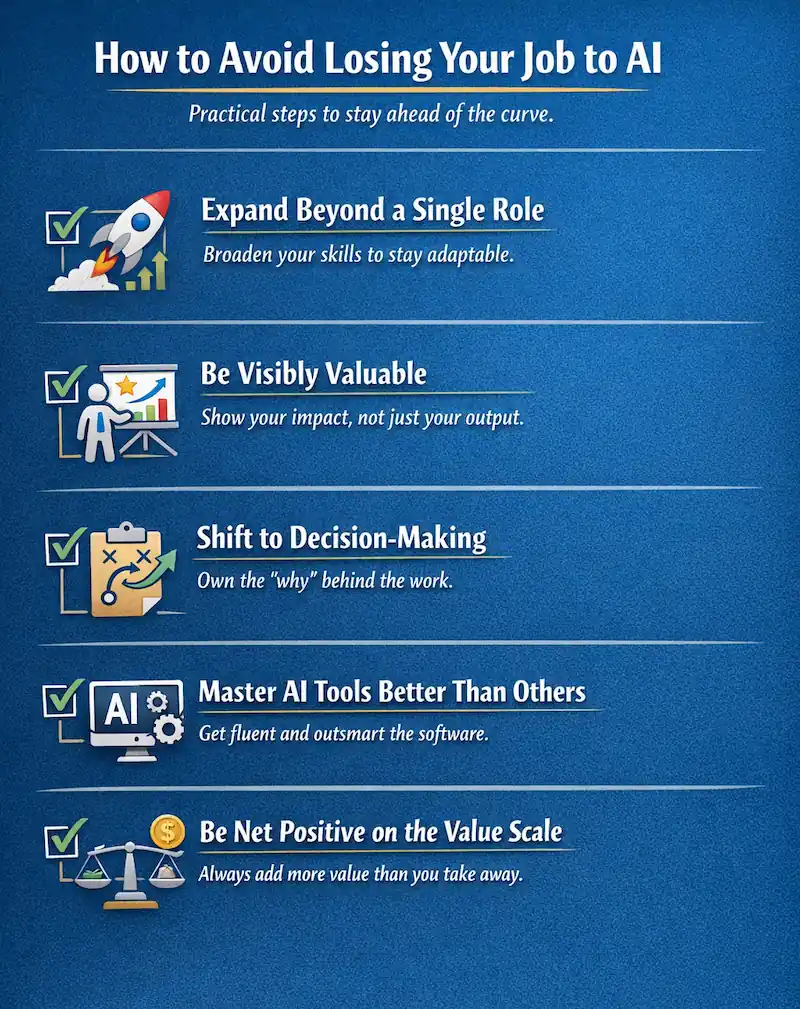
Expand Beyond a Single Narrow Role
The most replaceable workers are highly specialised in a single repeatable task. Broaden your skills across adjacent areas so you can adapt as technology changes. Long-term job security comes from flexibility, not niche repetition.
Be Visibly Valuable, Not Just Productive
Quiet efficiency—especially out of sight—is risky. Make your impact obvious. Share wins, insights, and ideas – Visibility matters more than ever. Contribute beyond your task list. When people understand how you think, not just what you deliver, you become much harder to replace.
Move From Execution to Decision-Making
AI executes brilliantly. But it struggles with deciding what should be done and why. Own priorities, outcomes, and trade-offs. Develop skills in strategy, problem framing, and teaching. The closer you are to decisions, the safer your role becomes.
Learn to Use AI Better Than Your Peers
You don’t need to become technical—but you do need AI fluency. Learn how to prompt AI, validate outputs, and integrate it into real workflows. Be the person who gets better results because of AI, not the one quietly replaced by it.
Always Be Net Positive on the Value Scale
Always add more value than you take away. Shift your mindset from “what do I need to do to get paid?” to “what more can I bring?” Increasing productivity is simply increasing value with the same resources—and that makes you indispensable.
Be Careful What You Wish For
Yes, we all want to work less, get paid more, and even better, work from the comfort of our homes. But I truly believe this is setting us up for failure.
The real threat of AI isn’t job loss — it’s complacency. The most vulnerable workers aren’t the least capable, but the most comfortable. When work becomes predictable it becomes replaceable.
There will be a massive push from government and industry to lift productivity. It is the only way we can sustain the lifestyle we all currently enjoy. AI will be a central tool in that push. That is unavoidable.
If your job can be broken into repeatable steps on a screen, AI will eventually learn parts of it. The real risk isn’t the technology, it’s staying in a role that never evolves, and complacent workers will be most exposed.
The safest move now isn’t to work harder or longer, but to move up the value chain toward judgment, creativity, and ownership—where humans still win.
AI isn’t a reason to panic.
It’s a reason to adapt—while you still have the advantage.
Until next time…

Leave a Reply