
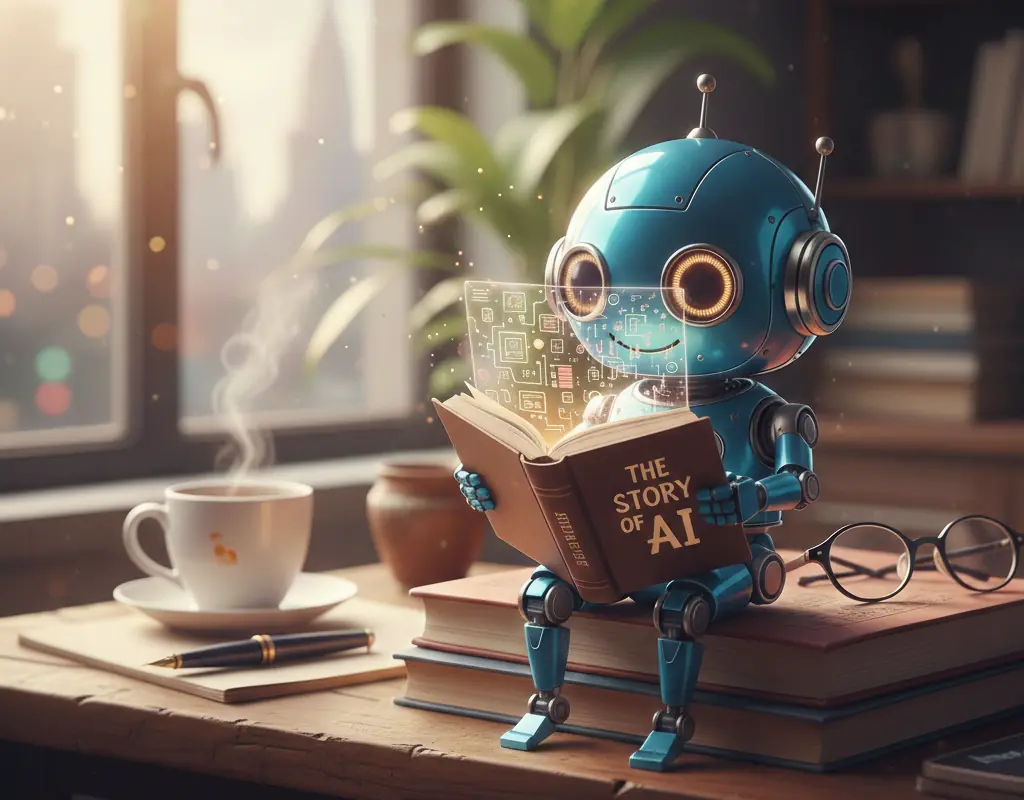

If you’ve been paying even a little attention to the news lately, it probably feels like artificial intelligence, or AI, has suddenly appeared everywhere.
It’s in headlines.
It’s in job discussions.
It’s in tools people swear will “change everything”.
It’s even in places you wouldn’t believe, like apparently my toaster 😆
In a previous post, I looked at what jobs AI is most likely to replace first, which raised an important follow-up question:
What is Artificial Intelligence really?
So this post is about answering just that – AI Explained Simply: What It Is, Where It Came From, and Where It’s Headed. You don’t need a tech background, and you don’t need to understand how computers work.
But a basic understanding of AI is becoming a necessity.
Let me explain…
Why AI Suddenly Feels Everywhere
AI didn’t suddenly get invented last year – it’s been around for decades. So why does it feel like it arrived last Tuesday out of nowhere?
For a long time, artificial intelligence was mostly hidden in the background on our laptops and phones — improving search results, recommending movies, sorting spam emails.
What changed recently is that AI became directly interactive. Instead of sitting behind the scenes, it started talking back.
Many people are encountering AI tools themselves directly for the first time – tools that generate text, images, and even computer code, etc. That shift has made AI feel new, powerful, somewhat personal, and in some cases, a little unsettling.
What Is Artificial Intelligence? (In Plain English)
The biggest mistake we make is thinking that AI “thinks” the way humans do. It doesn’t.
At its simplest, artificial intelligence is software that can learn from data and recognise patterns, rather than just following fixed instructions.
Traditional computer programs work like a recipe. If this happens, then do that. Every step is pre-written by a human. If the next step hasn’t been pre-programmed, the computer will not know what to do.
A traditional computer is just a very fast rule-follower. It has no room for creativity or learning.
Artificial Intelligence flips that model on its head. Instead of giving the computer the rules, we give it the data and the outcome we want, and the computer figures out the rules for itself.
“Autocomplete” on Steroids
The type of AI you’re likely seeing today (like ChatGPT or Google Gemini) is what researchers call Generative AI.
The best way to visualise this is to look at the “predictive text” on your smartphone. When you type “How are…” your phone suggests “you”. It does this because it has seen millions of people type that sentence before.
Instead of being told exactly what to do in every situation, it is trained on large amounts of data and learns patterns from that data. Based on what it has learned, it can then make predictions or generate responses when asked questions, or told to perform certain tasks.
It doesn’t “know” that the sky is blue because it has looked out a window; it knows that in billions of sentences, the word “blue” is the most statistically likely word to follow “The sky is…”. It is a prediction machine.
A helpful way to think about it is this:
Traditional software is programmed.
AI is trained and learns from ‘digesting’ large data sets.
A Brief (Non-Technical) History of AI
While it feels like AI appeared out of nowhere, the seeds were planted over 70 years ago.
The 1950s – The Dreamers
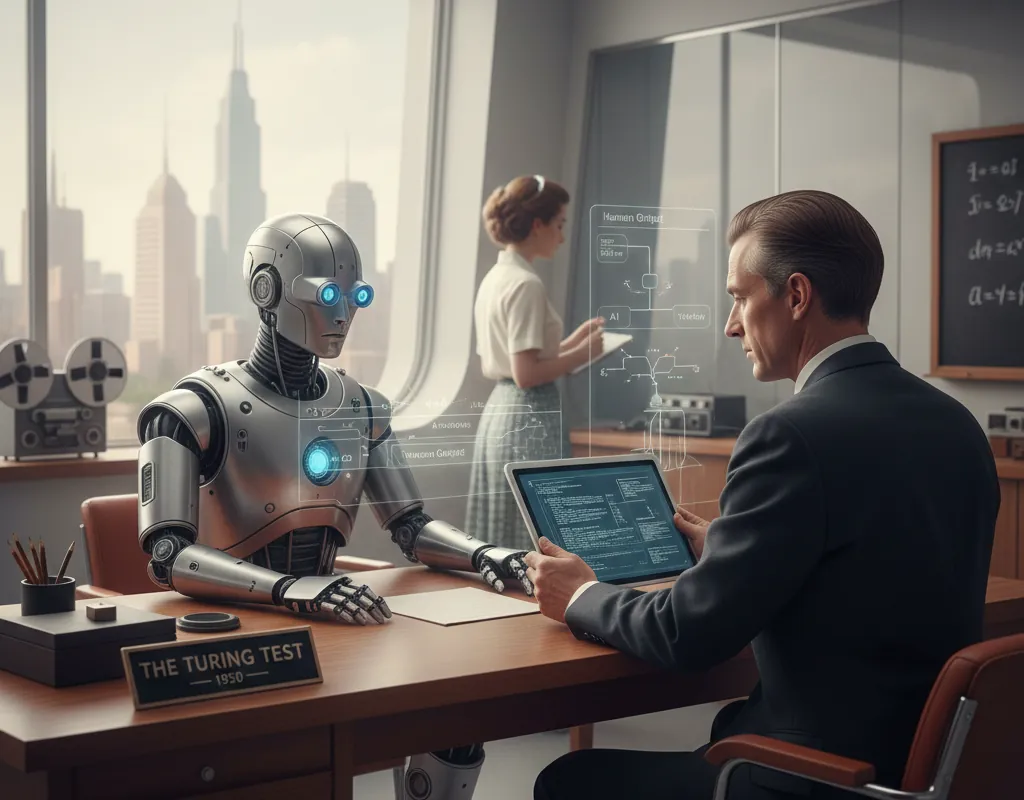
In 1950, a mathematician named Alan Turing asked a simple question: “Can machines think?”. He developed the “Turing Test” to see if a computer could fool a human into thinking they were talking to another person. At the time, the idea was purely theoretical—the computers of the 50s, while taking up whole buildings, were less powerful than a modern digital watch.
The “AI Winters”
For decades, AI went through cycles of hype followed by “winters”. Scientists would make big promises, the government would pour money in, but the technology would inevitably fail because the computers simply weren’t fast enough. These periods of silence are why many of us didn’t hear much about AI for a long time.
The Perfect Storm
So, why did it suddenly explode in the last few years?
Three things happened at once:
- The Big Data Boom: Thanks to the internet and social media, we finally had billions of digitised photos, books, and human conversations to “feed” the AI— we seem to love capturing our lives and sharing with the internet!
- Super-Powerful Chips: Companies like NVIDIA developed computer chips (GPUs) that could do billions of calculations per second—far faster than the chips in our home PCs.
- Neural Networks: Scientists perfected a type of math that mimics how human brain cells (neurons) connect.
When you combined massive data to learn from, with massive power to crunch all that data, and brain-like algorithms, the “prediction machine” finally started working at a level that felt, well, ‘human’.
Suddenly, systems trained this way didn’t just work—they worked shockingly well.
AI doesn’t replace people all at once. It replaces tasks quietly.
Understanding the basics gives you back a level of control.
The Next Stages: Where Are We Heading?
Today we have AI systems that are incredibly good at specific tasks only, but useless outside them. They don’t generalise well outside their training – they operate in specific ‘domains’ of work, where their learned knowledge is focused.
So what comes next? Well, this is where things get truly interesting.
From Chatbots to “Agents”
Right now, you have to go to an AI and ask it a question. The next stage is AI Agents. Instead of you saying “Write an email to my boss,” an agent would have the permission to go into your email, check your calendar, find a free slot for a meeting, and send the invite themselves. It moves from being a “search engine you talk to” to a “digital assistant that takes semi-independent action.”
Moving Toward AGI (Artificial General Intelligence)
The “Holy Grail” for researchers is AGI. This would be an AI that isn’t “narrow.” It wouldn’t just be good at one thing; it would be able to learn any task a human can. It could learn to play a new game, write a legal brief, and troubleshoot a plumbing issue all at once. We aren’t there yet—and experts disagree on whether we are five years or twenty years away—but this is the ultimate destination.
Reasoning and Logic
As I mentioned, current AI is a prediction machine. It’s great at sounding smart, but it often fails at basic logic (like a simple math word problem) because it’s just guessing the next word. The next major leap is teaching AI to reason. Developers want to move away from “What word comes next?” toward “Does this answer make logical sense?”.
It’s interesting that most people fear these next ‘stages’ of development (and rightly so). But most real-world impact is already happening with the ‘narrow’ AI we have today – it’s here that the biggest impacts are already occurring in the workforce, for example.
Why Understanding AI Matters
(Even If You’re Not “Technical”)
AI doesn’t replace people all at once. It replaces tasks quietly. It changes how work is done before it changes job titles.
That’s why understanding what AI is — and isn’t — matters more than reacting to headlines.
You don’t need to become an expert in AI, but misunderstanding it has consequences.
If you overestimate AI, you panic.
If you underestimate it, you will be impacted by real change.
If you understand it reasonably well, you can adapt calmly.
Clear understanding of AI leads to better decisions — about work, learning, and where to focus your energy. It helps you understand if your job may be under threat and what you can do about it. If you’re a parent like me, you can assist your children to understand the workforce of the future.
AI is often framed as something happening to people. In reality, it’s something being built by people, shaped by incentives, limitations, and choices.
Understanding the basics gives you back a level of control.
If there’s one idea worth holding onto, it’s this:
AI is a powerful tool, not an independent actor.
It doesn’t have goals.
It doesn’t have intentions.
It doesn’t decide what matters.
Humans still do all of that.
The challenge — and opportunity — is learning how to understand these tools without overestimating them or fearing them unnecessarily.
Until next time…



Leave a Reply to Gail Fuhrmann Cancel reply